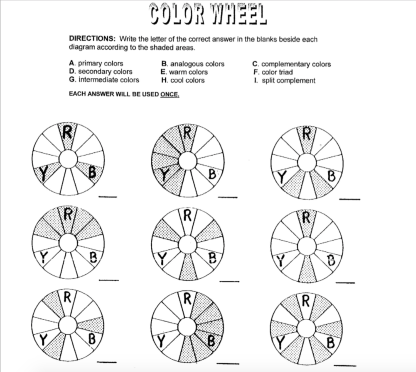
Color theory ordinary objects

color-wheel-theory

A, E, I, B, D, C, F, H, G

INSTRUCTIONS:

1.Draw an interesting, complicated object from 3 views using flat, graphic, contour shapes with no shading, only lines.  On a bigger sheet of watercolor paper, trace the 10 overlapping objects lightly. (Keep the paper neat, not too much graphite from your pencil & fingerprint free!) Go over the lines in thin sharpie.

2. In your sketchbook, name and color the 6 shapes in the following colors to reinforce your color theory knowledge:
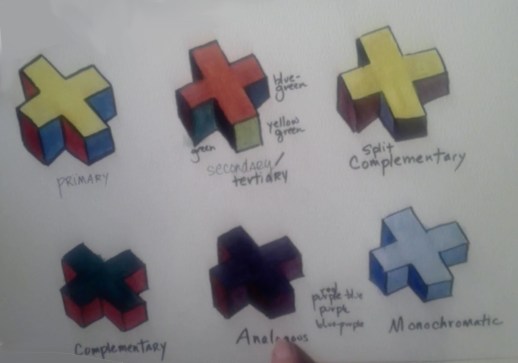
6-color-schemes-examples-color-theory

3. Paint each object in one color scheme neatly (the 10th is entire spectrum so make sure all the 6 colors on the color wheel show.

4. Give yourself a grade on the back using this rubric 1-4 and total grade:

      1. Everyday object drawn accurately in contour lines ink, from 3 different angles (as if it is falling).

      _____25pts.(Excellent) 15 (Good) 10 (Fair) 5 (Needs major improvement) 

      2. Each object is painted a different color scheme: Primary, Secondary, Intermediate (tertiary), Monochromatic, Analogous, Entire Spectrum, Warm colors, Cool colors,Complement, Split-complement in Watercolor.

      ______50pts (10 per item) (Excellent) 15 (Good) 10 (Fair) 5 (Needs major improvement) 

      3. Craftsmanship is observed: No smears, white (negative space) is clean.

      ______ 15 pts. (Excellent) 15 (Good) 10 (Fair) 5 (Needs major improvement) 

      4. Creativity: Unusual and/or complicated object chosen: 

_______ 10: pts(Excellent) 10 (Good) 8 (Fair) 6 (Needs major improvement.

 c8e0baa85d48e5412c6e50d868db2ff2Color Theory – Google Docs